|
Model Spaces
year: 1990 In 1989, when they were studying at the Rijksakademie in Amsterdam, Driessens & Verstappen found themselves in a situation that forced them to question the art practice. They were under the impression that a work of art seemed to be primarily a strategic instrument guaranteeing the continuity of the institutionalised art establishments. New artworks had to be shown every month, and production had to be kept up. The journals gave the most extensive and favourable reports to those galleries and art institutions buying big expensive pages of advertisements in their magazine. The so-called new and interesting seemed to be strongly intertwined with mutual commercial interest. The artists concluded that the art world was a generative system maintaining itself.
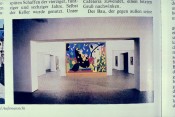
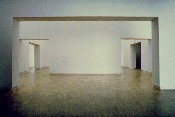
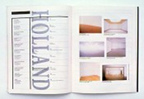
Twelve photographs taken from different art magazines served as a starting
point for the project that reflects this issue. They give a view of a gallery
or museum space where works of art are exhibited. Omitting the art works, the
depicted rooms have been mapped by means of perspective analysis. Based on
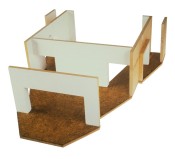
these drawings, 3-dimensional reconstructions could be made. This has resulted
in twelve architectural maquettes, each representing a section of an exhibition
room. These tabletop sections of rooms are detailed down to every discernible
element. Each one has its own lighting system.
This project has been realised in co-operation with Museum Fodor
and Rijksakademie Amsterdam.
|
|||
|
|
|
|